
12 Dec 25
Breathing might seem simple, but every inhale and exhale tells a story about how our lungs work. Spirometry helps make that story measurable, transforming each breath into data that doctors can analyze.
The test is performed with a spirometer, a medical device that measures airflow using specific technologies. Among the most common are turbine, pressure-based, and ultrasonic systems, each offering a distinct way of performing the tests.
Spirometers measure the volume and speed of air exhaled by the patient through a flow tube. Different technologies apply different physical principles to obtain these measurements. Let’s explore the three most common approaches used in modern spirometry.
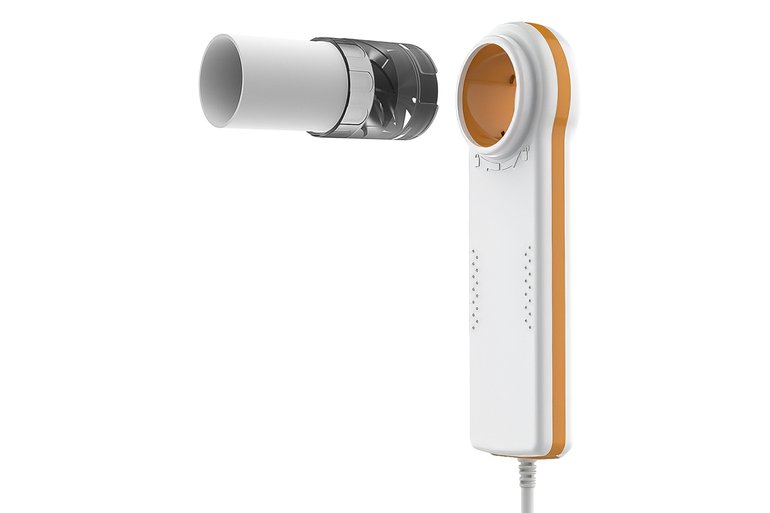
Turbine spirometers use a mechanical system where airflow causes the blades of a rotor to spin. The rotation speed is directly proportional to the airflow and is analyzed by a microprocessor.
This simple yet precise mechanism ensures reliable readings under a wide range of environmental conditions.
Turbine spirometers may use reusable or disposable turbines. Reusable models are designed to keep dust away from the sensor, maintaining accuracy over time, though they require some cleaning and disinfection. Disposable turbines, on the other hand, provide maximum hygiene and convenience: they are ready to use, require no calibration or cleaning, and ensure consistently reliable results with every test.
Ultrasonic spirometers calculate airflow by measuring the time it takes for ultrasonic waves to travel through the air inside the tube. Although highly sensitive, this method requires precise temperature and humidity compensation, as environmental variations can affect sound velocity and measurement accuracy.
This makes ultrasonic spirometers more suited for controlled clinical settings rather than portable or field applications.
Pressure spirometers rely on Bernoulli’s principle to determine airflow by measuring pressure differences across a constriction in the tube. The simplicity of the principle makes these devices popular, but accuracy can be affected by small variations in air density, temperature, and calibration.
Regular maintenance and frequent calibration are typically required to ensure consistent results.
Over the years, turbine spirometers have proven to be the most stable, versatile, and maintenance-free solution for both clinical and portable use. Their mechanical simplicity minimizes electronic interference, while their independence from temperature, pressure, and humidity ensures reliable performance anywhere — from hospitals to primary care and home settings.
Other key advantages include:
As a world leader in spirometry and oximetry, MIR has long relied on turbine technology, validated by independent studies for its precision, reliability, and long-term stability.
MIR’s devices also offer further advantages such as:
Find out more about our products and technology on the dedicated page.