
19 Oct 26
Chronic obstructive pulmonary disease (COPD) is one of the world's major health challenges. An estimated 480 million people are affected, and the disease causes approximately 3.7 million deaths each year, making it the third leading cause of death worldwide.
Despite its impact and advances in treatment, COPD remains substantially underdiagnosed. One likely contributing factor is the insufficient use of a simple, quick and non-invasive test: spirometry.
A diagnosis of COPD cannot be based solely on breathlessness, cough, sputum production or a history of exposure to tobacco smoke and other risk factors. These features raise clinical suspicion, but spirometry is required to confirm the diagnosis by demonstrating persistent airflow limitation.
The test is relatively simple, inexpensive and non-invasive. Yet it remains surprisingly underused.
A very simple question helps illustrate this discrepancy:
How many people have had an electrocardiogram at least once in their lives? And how many have had spirometry?
The intuitive answer is at odds with the prevalence and importance of respiratory diseases.
Even more surprisingly, spirometry is underused even in patients who have already been given a diagnosis of COPD.
Italian data clearly illustrate the problem.
In a large general practice population including more than 15,000 patients diagnosed with COPD, only 31.9% had undergone at least one spirometry test during the period studied. More recent Italian data indicate that, in settings where access to spirometry is not adequately organised, a substantial proportion of COPD diagnoses continue to lack spirometric confirmation (Ferrara F, et al. 2026).
The issue therefore concerns both the availability of a diagnostic tool and access to it in everyday clinical practice.
Spirometry has a remarkably long history. In 1846, John Hutchinson, the inventor of the spirometer, introduced the term “vital capacity” after observing that the volume of air exhaled following a maximal inspiration provided information about health status and survival.
From its inception, therefore, spirometry was intended not merely to measure a lung volume, but to derive clinically meaningful information from a physiological measurement.
Almost two centuries later, spirometry interpretation still relies primarily on a small number of parameters, particularly FEV₁, FVC and the FEV₁/FVC ratio. These are fundamental measures: they allow airflow limitation to be identified and its severity to be quantified.
But the spirometric manoeuvre yields much more than these numbers.
A flow–volume curve is generated during forced expiration. Its shape depends on the interplay between lung elastic recoil, airway characteristics and the dynamic behaviour of the airways during expiration.
The shape of the curve therefore contains physiological information that is not fully captured by FEV₁, FVC and FEV₁/FVC alone.
Pulmonologists have long recognised this: when interpreting spirometry, they examine both the numerical values and the shape of the curve. Traditionally, however, this assessment has been predominantly qualitative.
Digital technologies now allow some of these features to be analysed quantitatively, without changing the spirometric manoeuvre, extending the test or requiring patients to undergo additional procedures.
The Emphysema Severity Index (ESI) was developed in this context. It is an index automatically derived from the shape of the expiratory portion of the flow–volume curve (Occhipinti M, et al. 2019).
ESI does not require a new manoeuvre: it uses information already generated during conventional spirometry and expresses it as a quantitative score ranging from 0 to 10.
The aim is to complement traditional spirometric parameters by extracting additional information about disease pathophysiology from the same forced expiration.
More information from the same spirometry test
Spirometry remains essential for diagnosing COPD, but the information it can provide extends beyond demonstrating airflow limitation.
The ability to analyse the shape of the expiratory curve quantitatively represents a natural evolution of a test designed, from its inception, to obtain clinically meaningful information through a simple physiological measurement.
ESI is part of this evolution: it is a way to obtain more information from the spirometry we already perform, without introducing a new test.
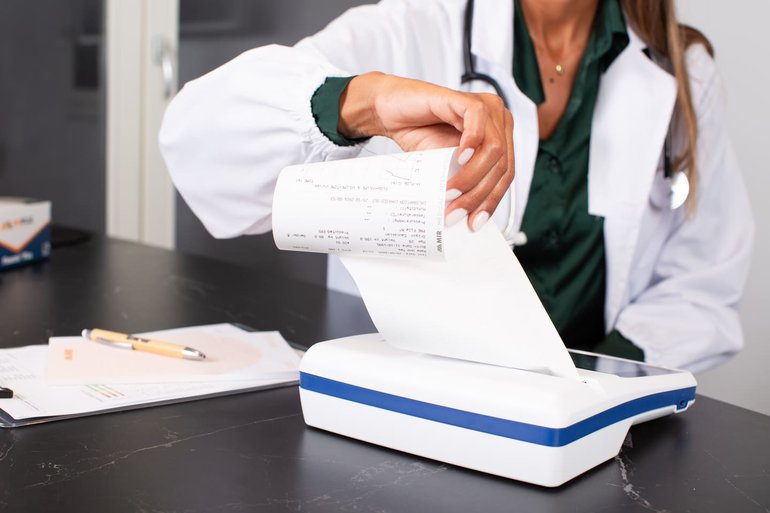
The Emphysema Severity Index (ESI) is now integrated into two professional MIR spirometers, designed to meet different needs in clinical practice:
Both devices automatically calculate ESI alongside traditional spirometric parameters, providing additional information without changing how the test is performed.


